 LITTORALICIOUS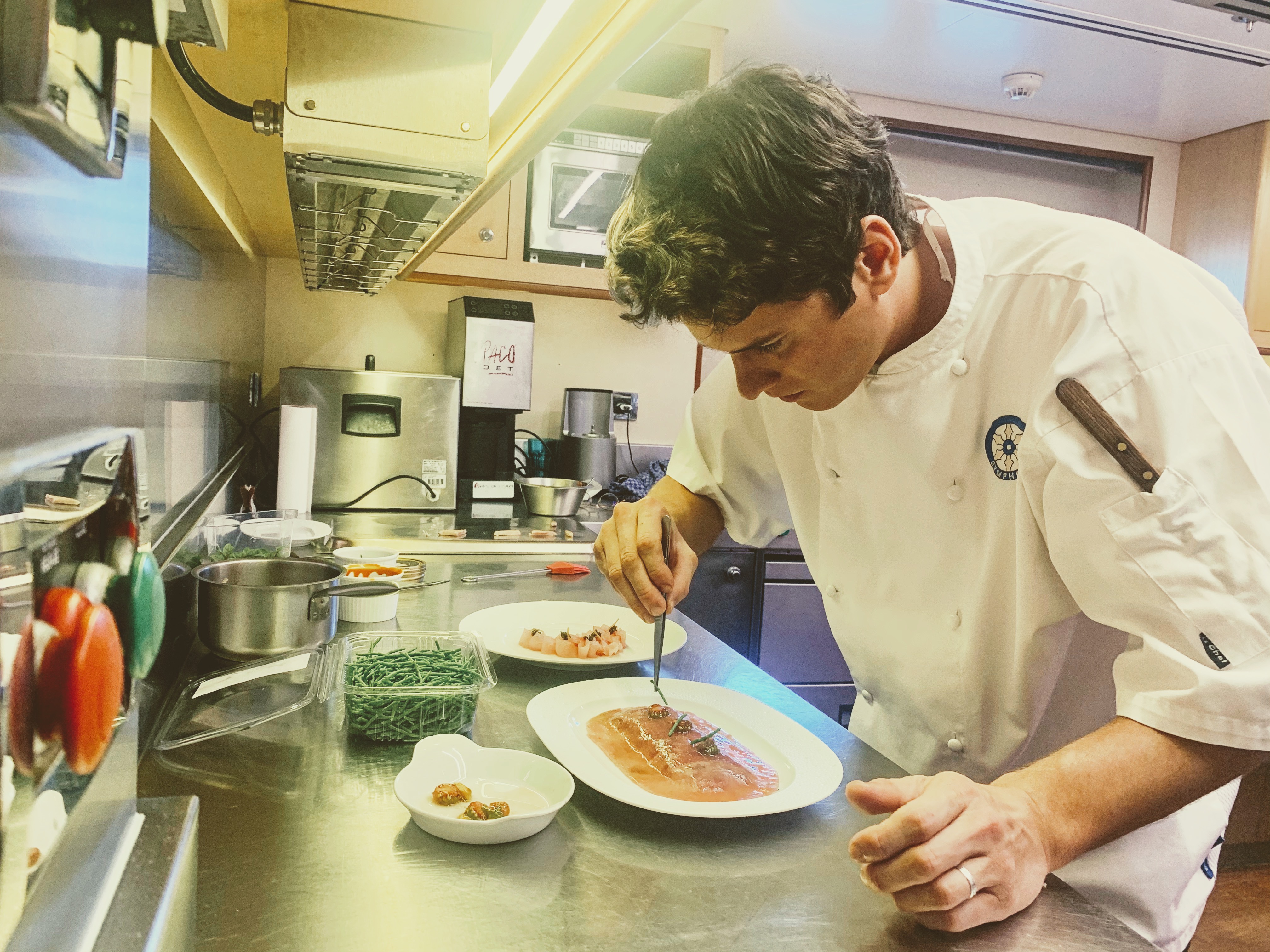
Arnaud Callier
Head Chef · SuperyachtA decade at sea. Galleys from 22 metres to 100+. I cook while the floor moves, provision in ports where I don't speak the language, and serve plates that get photographed by guests who've eaten at the best restaurants on earth. I built Littoralicious because nobody writes for us.


The Table I Came From
Before any of it, there was my grandmother's table. She was always cooking—lunch, dinner, it didn't matter—and I always went to her to eat. Her kitchen was where I could talk, share, and simply feel good. She cooked the best dishes, the ones I'm still happy to sit down to every time I'm back. She gave me the first thing I ever understood about food: that a table is a place for good time together, and for unconditional love. Everything I do now comes from there.
From the Mountains
I grew up in the Jura—the mountains of eastern France, about as far from the sea as this country gets. I finished science A-levels at eighteen and left—not for a career, but to find out what the world was really like. I'd been reading Thoreau, London, Byron and the navigators, Kersauson and Moitessier, and I wanted two things: to travel, and to learn English. Australia answered both. I worked my way across it—factories, kitchens, whatever paid—until a galley finally caught me. The science never left; it's the lens I still cook through.
The Knife in Darwin
The kitchen found me washing dishes in a Mexican restaurant in Darwin. Short-handed after lunch, the chef put a knife in my hand and showed me my first cuts—hands-on, beside someone who knew his craft. That's where cooking began for me, not in a book. Australia is where I started sailing too: first lessons in Sydney Bay, then a seat on regatta crews just by asking at the dock. Surprising, really: a Frenchman from a landlocked corner of France learned to cook — and to sail — in Australia, on the far side of the world.
The Galley Found Me
A course in Thailand showed me the industry even existed: yachting, where you're paid to cook and sail at once. I cooked my first seasons in the galley on smaller boats — then went ashore for real training. One letter to a three-Michelin-star house in the South of France put me on the opening team of their new restaurant near Aix-en-Provence: chef de partie within the month, our first star six months after we opened. That kitchen taught me excellence and dedication — and it opened the doors to the megayachts.
The megayachts came next — a decade at sea, five oceans, galleys from claustrophobic to world-class. Symphony, where I learned what "owner's standards" really mean. Vava II, Christina O. and Kismet, feeding crews that live at sea, provisioning in ports where I didn't speak the language.
What the Sea Taught Me
The galley is the most demanding kitchen on earth. You cook while the floor moves, your walk-in is the size of a closet, the nearest supplier is a day's sail away, and the guest count changed an hour ago.
It exposes bullshit instantly. Recipes that assume stable conditions fail; techniques that work on land break at twelve knots in a beam sea. What survives is understanding. If you know why an emulsion holds, you know what to do when it breaks. If you understand Maillard chemistry, heat and humidity become variables you adjust, not mysteries that defeat you.
That's the whole reason for Littoralicious. Technique without understanding is just mimicry—and the understanding is the part worth sharing.
"GREAT IDEAS ARE MEANT TO BE SHARED."

The Fleet
Ashore
Cuisines: French, Mediterranean, Japanese, Nikkei, Peruvian, Italian, Thai, Indian, Spanish, Mexican, Moroccan, Middle Eastern, Greek, Vietnamese
Dietary: Vegan, Vegetarian, Kosher, Gluten-free, Whole 30, Nutritionally Conscious, Medicinal Food
Certifications: Ship's Cook Certificate, STCW 10 (MCA), ENG 1, Food Safety Level 2, WSET Oenology Level 2, Intl. Bareboat Skipper
Languages: French (native), English (fluent), Spanish (conversational), German (conversational)
From the Galley
Passionate about the science beneath cooking, nutritionally conscious cuisine, and regional traditions from the littoral.